 FreeWill Labs
History Is Easier to Understand When You’re Standing Inside It
For adults, arriving somewhere historically important can carry its own sense of significance. We already know that Rome is ancient. We understand why the Freedom Trail matters. We recognize the monuments in Washington, D.C.
Kids don’t necessarily arrive with that context. To them, an old building can simply look like an old building. Another church becomes another church. Another painting becomes another painting. Another plaque filled with dates becomes something to walk past on the way to lunch.
That doesn’t mean kids aren’t interested in history. Often, they just haven’t been given a reason to care yet.
Start With a Story, Not a Date
Consider these two introductions:
“This building was constructed in 1713.”
and:
“Imagine standing here when Boston was so small that almost everyone knew everyone else—and an argument inside this building could spread through the entire town.”
The date may eventually matter. The story creates the doorway.
Before asking children to remember when something happened, help them understand who was here, what they wanted, what they were afraid of, what decision they had to make, what the place would have looked or sounded like, and what happened next.
Give Kids Something to Investigate
Passive sightseeing puts adults in charge of the experience. Adults read the sign. Adults explain the history. Adults decide what matters.
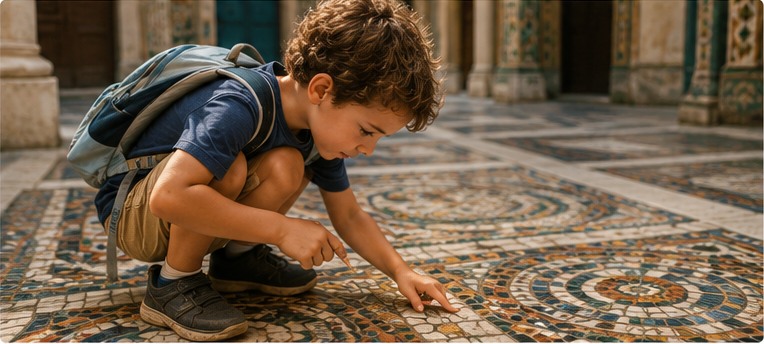
Try reversing that relationship. Ask your kids to find something.
- At a historic building, look for the oldest object they can see.
- At a cathedral, hunt for animals hidden in carvings.
- At a monument, look for symbols and figure out what they might mean.
- At an archaeological site, identify something that would have been part of ordinary life.
- At a museum, choose one person in a painting and invent the question you would ask them.
Suddenly the child isn’t just receiving information. They’re investigating.
Use the Place Itself
One of the great advantages of travel is that history has physical evidence. Use it.
Notice how narrow the streets are. Look at how tall the walls were. Find the river that made the city possible. Stand where a crowd once stood. Look up at the ceiling an artist spent years painting.
Ask, “Why do you think they built it this way?”
You don’t always need to know the answer. Wondering together is part of the experience.
Don’t Try to Teach Everything
This is one of the easiest traps for adults. You paid to come here. There are 47 important things. Therefore everyone should learn all 47 important things.
That’s rarely necessary.
If your child leaves the Colosseum fascinated by gladiators but remembers almost nothing about Roman politics, the visit wasn’t wasted. If they leave an art museum obsessed with one Van Gogh painting, that’s a win.
A few vivid memories can become anchors. Children can attach more knowledge to them later.
Let Technology Encourage Looking—Not Replace It
Phones don’t automatically make travel less meaningful. It depends on what they’re asking us to do.
Technology can prompt a child to find a gargoyle, photograph an architectural detail, solve a clue, locate a landmark, record a discovery, or follow a story through a city.
The screen becomes a prompt. The world remains the experience.
That’s the philosophy behind Adventure Quest: use a little technology to encourage families to notice more of what’s actually around them.
Let Kids Remember History Their Way
Your favorite memory might be standing inside an extraordinary cathedral. Your child’s might be the strange face they found carved into one corner of it.
That’s okay.
The goal isn’t to manufacture the same memory for everyone. It’s to create enough curiosity that everyone finds something worth remembering.
History comes alive when it stops being a collection of facts about people who lived a long time ago. It becomes a trail of evidence—and your kids get to investigate it.
Return to Adventure Quest Journal: Issue No. 2 — History Comes Alive